


 August 17, 2026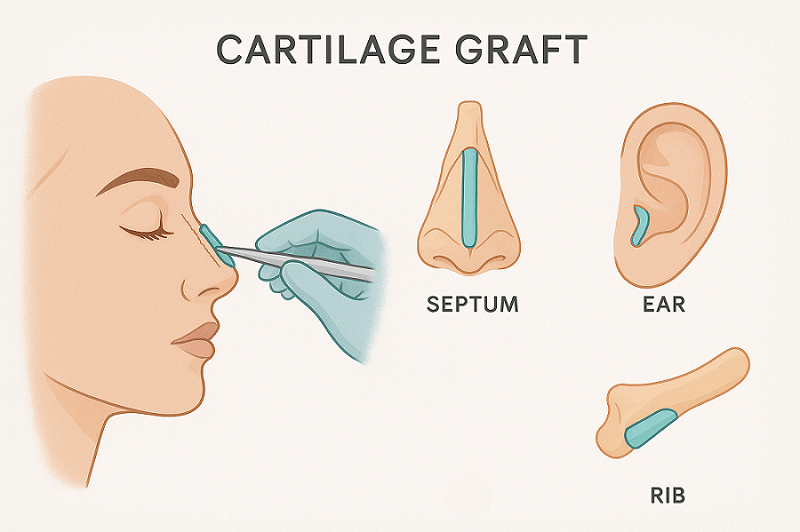
In many revision rhinoplasty procedures, additional cartilage is needed to restore nasal structure, improve support, and correct deformities resulting from previous surgery. This is particularly important when a significant amount of septal cartilage has already been used during an earlier operation.
The three main sources of cartilage used for nasal reconstruction are septal cartilage, auricular cartilage from the ear, and costal cartilage from the rib. Each source has different characteristics, advantages, and applications, and the appropriate choice depends on the patient’s anatomy and the extent of reconstruction required.
Why Is Cartilage Needed in Revision Rhinoplasty?
Previous nasal surgery can alter or reduce the structural framework of the nose. In some patients, cartilage that was previously used to support the nasal tip, bridge, or other structures may no longer be available in sufficient quantity.
Additional cartilage grafts in revision rhinoplasty may therefore be required to restore structural support, improve nasal symmetry, refine the nasal tip, augment the dorsum, or support the internal nasal valve.
The need for cartilage depends on several factors, including:
- The amount of cartilage remaining after previous surgery
- The type and severity of the nasal deformity
- The condition of the nasal framework
- The amount of structural correction required
- The patient’s individual anatomy and surgical goals
Main Sources of Cartilage for Rhinoplasty
When additional cartilage is required, surgeons generally consider three main autologous sources. The choice is based on the amount, strength, flexibility, and shape of cartilage needed for the reconstruction.
Septal Cartilage
Septal cartilage is often a preferred graft source when sufficient cartilage remains after previous surgery. It is relatively straight, strong, and located within the nasal surgical field.
Auricular Cartilage
Auricular cartilage, commonly known as ear cartilage, is more flexible and naturally curved. These characteristics make it useful for selected nasal tip and contour corrections.
Costal Cartilage
Costal cartilage, or rib cartilage, provides a larger and stronger source of autologous cartilage. It is particularly useful in complex revision rhinoplasty procedures that require substantial structural support or graft volume.
Septal Cartilage in Revision Rhinoplasty
The nasal septum is the central structure that separates the right and left nasal cavities. Its cartilage contributes significantly to the structural support and stability of the nose.
During rhinoplasty, selected portions of the septal cartilage can be harvested while preserving the structural framework necessary for nasal function and stability. For this reason, septal cartilage is often considered one of the most useful sources for nasal grafting when an adequate amount is available.
Why Is Septal Cartilage Often Preferred?
Septal cartilage has several characteristics that make it particularly suitable for nasal reconstruction:
- It is relatively straight and strong.
- It can be precisely shaped for different grafting applications.
- It is located within the surgical field.
- It does not require a separate donor-site incision.
- It can be used to reinforce important nasal structures.
What Can Septal Cartilage Be Used For?
Depending on the patient’s anatomy and surgical requirements, septal cartilage can be shaped into different types of structural grafts.
- Spreader grafts: Used to support the middle vault and help improve the function of the internal nasal valve.
- Columellar strut grafts: Used to strengthen and support the nasal tip and columella.
- Structural grafts: Used to restore or reinforce weakened areas of the nasal framework.
When Is Septal Cartilage Not Available?
In revision surgery, the available septal cartilage may be limited because a significant portion may have already been harvested during a previous rhinoplasty.
Additional cartilage may also be required in cases involving:
- Previous nasal trauma
- Significant septal cartilage deficiency
- Major structural deformities
- Extensive nasal reconstruction
- Multiple grafting requirements
When the remaining septal cartilage is insufficient, the surgeon may consider auricular cartilage or costal cartilage as alternative autologous sources.
Auricular Cartilage in Revision Rhinoplasty
When septal cartilage is insufficient, auricular cartilage can provide a useful alternative for selected nasal reconstruction procedures. Its flexibility and natural curvature make it particularly suitable for certain nasal tip and contour corrections.
Why Is Ear Cartilage Used?
Compared with septal and rib cartilage, ear cartilage is relatively flexible and naturally curved. These characteristics can be advantageous when delicate shaping is required, especially in selected nasal tip refinement procedures.
Auricular cartilage can also be useful for correcting specific contour irregularities and providing additional support in carefully selected cases.
What Is Auricular Cartilage Best Used For?
Depending on the surgical requirements, ear cartilage may be used for:
- Nasal tip refinement
- Selected contour corrections
- Soft structural support
- Correction of certain minor to moderate irregularities
How Is Auricular Cartilage Harvested?
Auricular cartilage can generally be harvested through an incision placed either on the front or back of the ear. The approach depends on the patient’s anatomy and the amount and location of cartilage required.
- Anterior approach: The incision is made on the front surface of the ear.
- Posterior approach: The incision is placed behind the ear, where the resulting scar is generally well concealed.
The Role of Auricular Perichondrium
The auricular perichondrium is the thin connective-tissue layer surrounding the cartilage. Preserving or incorporating the perichondrium when appropriate can be useful during cartilage harvesting and graft preparation.
In selected cases, the perichondrium can also contribute to smoother graft contours and may be particularly helpful when working with thin nasal skin.
Does Ear Cartilage Harvesting Affect the Ear?
Mild swelling, tenderness, or temporary discomfort may occur at the donor site during the early recovery period. With appropriate surgical technique and preservation of the ear’s supporting structures, cartilage harvesting is generally performed without affecting hearing.
The ear typically maintains its natural contour as healing progresses.
Costal Cartilage in Revision Rhinoplasty
Costal cartilage, also known as rib cartilage, is an important source of graft material for complex nasal reconstruction. It is particularly useful when a large amount of strong cartilage is required or when septal and auricular cartilage are insufficient.
Why Is Rib Cartilage Used?
The main advantages of rib cartilage in rhinoplasty include its strength, volume, and versatility. These properties make it especially valuable in complex revision rhinoplasty cases.
- High structural strength: Provides substantial support for the nasal tip and dorsum.
- Adequate volume: Provides a relatively large amount of graft material for extensive reconstruction.
- Autologous tissue: Comes from the patient’s own body.
- Versatility: Can be carved and shaped into different graft configurations.
How Is Rib Cartilage Harvested?
Rib cartilage is typically harvested through a carefully placed incision on the chest wall. The amount of cartilage removed depends on the patient’s anatomy and the requirements of the nasal reconstruction.
After harvesting, the cartilage is carefully prepared and sculpted into the appropriate shape before being used as a nasal graft. The surgical technique is designed to preserve the stability and function of the chest wall.
What Is Costal Cartilage Used For?
Costal cartilage grafts can be used for a variety of reconstructive purposes, including:
- Onlay grafts: Used to augment or restore the nasal dorsum.
- Spreader grafts: Used to support the middle vault and internal nasal valve.
- Columellar strut grafts: Used to strengthen and support the nasal tip.
- Diced cartilage wrapped in fascia (DCF): Used in selected cases to improve contour irregularities and fill depressions.
Septal vs. Auricular vs. Costal Cartilage
Each cartilage source has different characteristics. The most appropriate option depends on the patient’s anatomy, the amount of cartilage available, and the structural requirements of the reconstruction.
| Feature | Septal Cartilage | Auricular Cartilage | Costal Cartilage |
|---|---|---|---|
| Strength | High | Moderate | Very high |
| Flexibility | Moderate | High | Low to moderate |
| Available volume | Limited | Limited to moderate | High |
| Common applications | Structural support | Tip and contour refinement | Major reconstruction |
| Donor site | Nasal septum | Ear | Rib/chest |
| Separate donor-site incision | No | Yes | Yes |
How Do Surgeons Choose the Right Cartilage Source?
There is no single cartilage source that is ideal for every revision rhinoplasty patient. The decision is based on the patient’s individual anatomy and the specific goals of reconstruction.
Important factors include:
- The amount of septal cartilage remaining
- The severity and type of nasal deformity
- The degree of structural deficiency
- The amount of cartilage required
- The area that needs reconstruction, such as the tip or dorsum
- The thickness and characteristics of the nasal skin
- The condition of potential donor sites
A thorough preoperative examination allows the surgeon to determine whether septal cartilage is sufficient or whether ear or rib cartilage would provide a more appropriate source for reconstruction.
Cartilage Grafts Used in Revision Rhinoplasty
Different types of grafts can be created from septal, auricular, or costal cartilage. The choice of graft depends on the specific structural problem that needs to be addressed.
Spreader Grafts
Spreader grafts are placed between the septum and upper lateral cartilages to support the middle vault. They can also help improve the function of the internal nasal valve in appropriately selected patients.
Columellar Strut Grafts
Columellar strut grafts provide support to the nasal tip and columella. They may be particularly useful when the tip has lost structural support following previous surgery.
Onlay Grafts
Onlay grafts can be used to increase or restore the height and contour of the nasal dorsum or to correct selected contour deficiencies.
Diced Cartilage Grafts
Diced cartilage consists of small pieces of cartilage that can be used for selected contour corrections and augmentation procedures.
Diced Cartilage Wrapped in Fascia
Diced cartilage wrapped in fascia (DCF) can be used in selected cases to create a smoother contour and correct depressions or irregularities of the nasal dorsum.
What Are the Benefits of Using Your Own Cartilage?
Autologous cartilage means that the graft material is obtained from the patient’s own body. This makes it an important option for structural nasal reconstruction, particularly when significant support is required.
Potential advantages include:
- Good tissue compatibility
- No permanent synthetic implant is required
- Ability to provide structural support
- Versatility in shaping and graft design
- Availability of different donor sources according to the patient’s needs
Recovery After Cartilage Harvesting
Recovery depends on the cartilage source and the extent of surgery. In addition to recovery from the nasal procedure itself, patients may experience temporary discomfort or swelling at the donor site.
Recovery After Septal Cartilage Harvesting
Because the septum is already part of the surgical field, no separate external donor-site incision is required. Recovery is therefore primarily associated with the nasal procedure.
Recovery After Ear Cartilage Harvesting
Mild swelling, tenderness, or temporary discomfort around the ear may occur after harvesting. These symptoms generally improve as healing progresses.
Recovery After Rib Cartilage Harvesting
Rib cartilage harvesting may cause temporary discomfort at the chest donor site. The recovery period varies depending on the amount of cartilage harvested and the individual patient’s healing process.
Frequently Asked Questions About Cartilage in Revision Rhinoplasty
Can cartilage be taken from the nose during revision rhinoplasty?
Yes. If sufficient septal cartilage remains after previous surgery, it may be harvested and used for reconstruction. However, many revision patients have limited remaining septal cartilage and may require another donor source.
What happens if there is not enough septal cartilage?
When the remaining septal cartilage is insufficient, the surgeon may consider auricular cartilage or costal cartilage depending on the amount and type of reconstruction required.
Is ear cartilage better than rib cartilage for rhinoplasty?
Neither is universally better. Ear cartilage is more flexible and may be useful for selected tip and contour corrections, while rib cartilage provides greater strength and volume for extensive structural reconstruction.
Why is rib cartilage used in revision rhinoplasty?
Rib cartilage provides a relatively large amount of strong cartilage and can therefore be useful when substantial structural support or extensive reconstruction is required.
Does taking cartilage from the ear change its shape?
With appropriate surgical technique and preservation of the ear’s supporting structures, cartilage harvesting is generally performed while maintaining the natural shape and function of the ear.
Does rib cartilage provide long-term support?
Rib cartilage can provide strong structural support in nasal reconstruction. However, the long-term behavior of a graft depends on factors such as graft preparation, surgical technique, placement, and individual healing.
Which cartilage is best for revision rhinoplasty?
The best cartilage source depends on the individual patient. Septal cartilage may be preferred when enough remains, auricular cartilage can be useful when flexibility is needed, and costal cartilage is often considered when greater volume and structural strength are required.
Conclusion
Cartilage grafting in revision rhinoplasty plays an important role in restoring nasal structure, improving support, and correcting deformities that may remain after previous surgery.
Septal cartilage, auricular cartilage, and costal cartilage each have distinct characteristics and applications. Septal cartilage is often preferred when sufficient material remains, ear cartilage provides flexibility for selected tip and contour corrections, and rib cartilage offers substantial strength and volume for more extensive reconstruction.
Ultimately, the appropriate cartilage source should be selected based on the patient’s anatomy, the nature of the deformity, the amount of reconstruction required, and the surgeon’s experience with complex nasal surgery.


 No 32, Vallinezhad St., Vanak Square, Tehran, Tehran Province, Iran